When I cam across The Lopez Museum & Library‘s event online, I didn’t know what to expect. The event was titled, “A Visayan Nayánayá: Food as a Pursuit of Happiness” and it was being hosted at one of the meeting rooms at Rockwell Club, with a lecture by food historian Felice Prudente Sta. Maria with merienda being served by the legendary Chef Jessie Sincioco. I had never really thought about how merienda would differ between Luzon and Visayas. Wasn’t it mostly kakanin anyway?
Merienda is a traditional light meal or snack eaten between main meals, originating from the Spanish and Latin American custom and deeply embedded in Filipino culture.
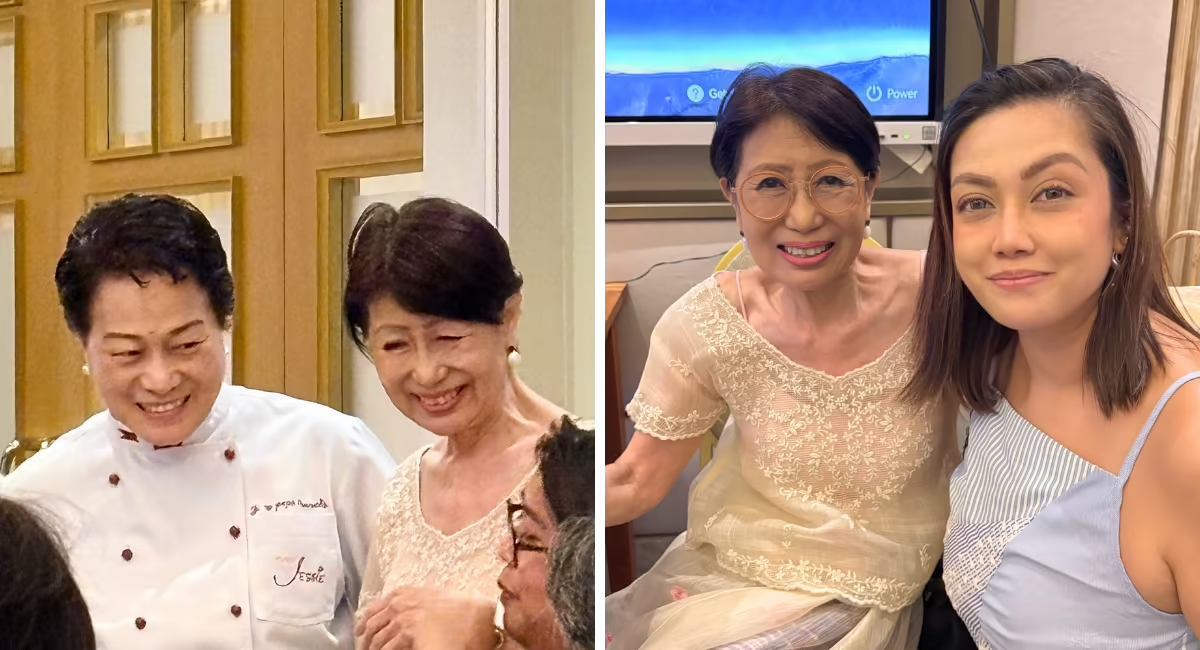
I found myself in one of the meeting rooms at Rockwell Club, doing that thing where you try to look like you belong while quietly wondering how everyone else seems to know everyone. Most of the guests appeared to be museum insiders or friends of the lecturer, already deep in conversation while I hovered somewhere at the edges, taking it all in. Felice, meanwhile, was impossible to miss. Tiny and lithe in her baro’t saya, she moved around the room with an energy that seemed to take up twice her physical space, greeting guests and making small talk as she went. Chef Jessie was doing the rounds, too, though with a more serious air about her. You could tell she had poured considerable time and energy into researching the dishes and developing versions that would make our ancestors proud.
Once everyone had settled in, Chef Jessie gave a quick overview of her process and how they had meticulously researched and tested the recipes to arrive at the dishes we would be served later that day. It always amazes me to hear the thought process behind a dish, as well as how difficult it can be for chefs to source the right ingredients to recreate something I would probably scarf down without a second thought.
Felice began her lecture with the Spanish arrival in the Visayas, where much of our recorded history begins (because history is dictated by the colonizer, but that’s another story for another day). Magellan had set out with the rather confident assumption that there would be plenty of little islands scattered between the Pacific Ocean and the Spice Islands (aka Indonesia), where they could restock their supplies along the way. Except they found no such islands, and the brutal 99-day journey left Magellan and his crew starving and desperate enough to eat the leather wrappings around the masts.
When they finally sighted land in Guam, they must have thought they had found respite and food for their starving crew. Instead, the Chamorro people rowed out in their fast outrigger canoes, boarded the ships, and took whatever they could get their hands on, including rigging, knives, and the captain’s skiff. This was apparently enough for Magellan to name the Mariana Islands Islas de los Ladrones, or Islands of Thieves.
After that traumatic encounter, Magellan and his crew finally made it to Samar, where fishermen from nearby Suluan Island spotted the foreign ships and approached them with food, wine, and tropical fruits. In hindsight, I kind of wish they’d robbed them, too, and saved us 333 years of strife. But it seems Filipino hospitality and pakikipagkapwa were already part of our DNA long before colonization.
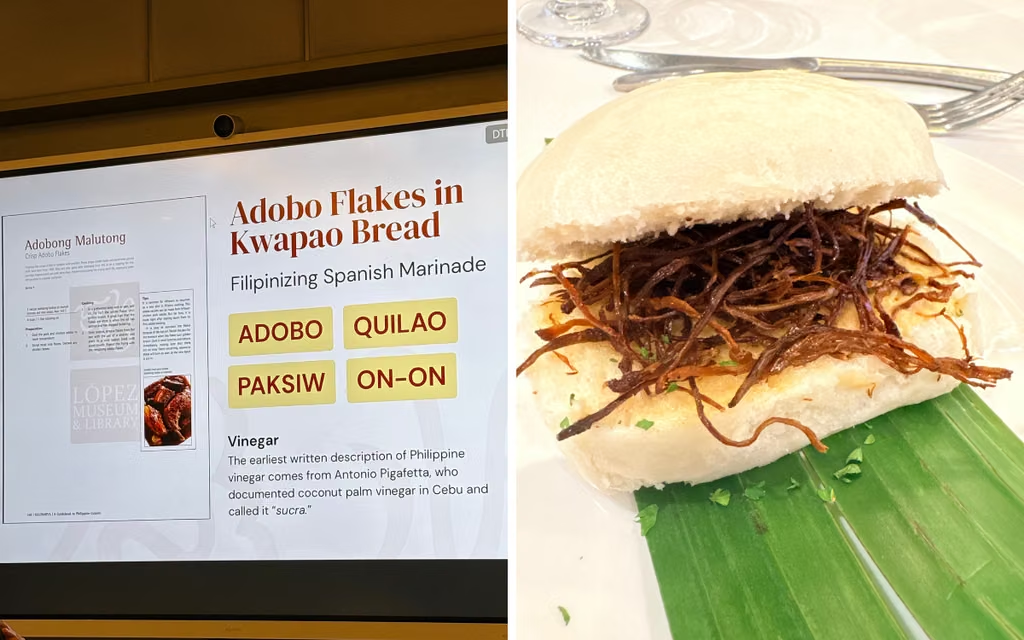
Fast-forward through 333 years of Spanish colonization, and a lot had changed in the Filipino diet. Not just what we ate, but how we ate it. Take adobo, one of the most popular and versatile dishes in Filipino cuisine. For us, it means a meal; in other Spanish-speaking countries, adobo refers to a method of preparing food, usually by marinating it in a seasoned mixture.
As Felice Prudente Sta. Maria explained, pre-colonial Filipino cooking had no direct equivalent for the Spanish method of braising meat in its marinade. We prepared food in all sorts of ways: fresh, steamed, grilled, or cooked in vinegar. But braising, as the Spanish understood it, wasn’t part of our culinary vocabulary. So when the Spanish settlers asked their Filipino helpers to braise the food that had been marinated in spices — the adobo — the instruction got lost in translation. The Filipinos understood adobo to be the name of the dish itself, rather than the process. And so, a word that originally described a method of preparation became the name of a dish we now consider distinctly Filipino.
But food, as Felice’s talk reminded us, has always been about more than what ends up on our plates. In her work on Filipino food culture and history, she highlights nayanaya, a tradition in which feeding others goes beyond satisfying physical hunger. It’s about nourishing the need for connection, cheer, and community — a way of making people feel welcome and cared for through food.
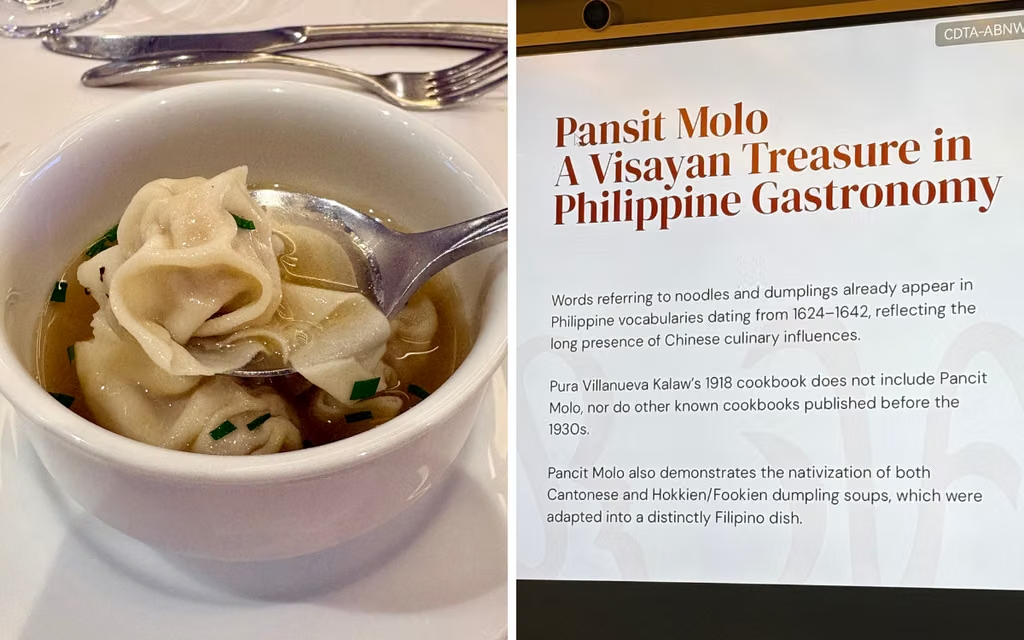
I was wondering why Chef Jessie had pansit molo on the list of merienda items. Wasn’t it just an ordinary comfort rainy day food we probably inherited from Chinese traders back in the day? Well, yes, but with a distinctly Visayan twist.
The word pansit comes from the Hokkien 便食 (pián-ê-si̍t), commonly associated with convenient or quick food. Over time, Filipinos came to use the word specifically for noodles. Ironically, there isn’t a single noodle in pansit molo. Instead, the pansit refers to the thin wonton or molo wrappers used to make the pork and shrimp dumplings. A little confusing, if you ask me.
The dish traces its roots to Molo, a district in Iloilo that became a Chinese quarter and an important center of commerce during the Spanish colonial period. Chinese merchants who settled there adapted the wonton soup of their homeland using local ingredients, with the addition of toasted garlic bits — a garnish that wouldn’t feel out of place in our Spanish-influenced cuisine.
Even the name Molo has an interesting story attached to it. According to one popular local folklore, Chinese residents, who supposedly struggled with the Spanish-influenced pronunciation of the letter “r,” would substitute it with an “l.” When warning townspeople of approaching Moro pirate raids, they would supposedly shout, “Molo! Molo!” The name eventually stuck to the district.
Whether or not the story holds up historically, it’s a reminder of how much cultural exchange is folded into something as seemingly ordinary as a bowl of soup.
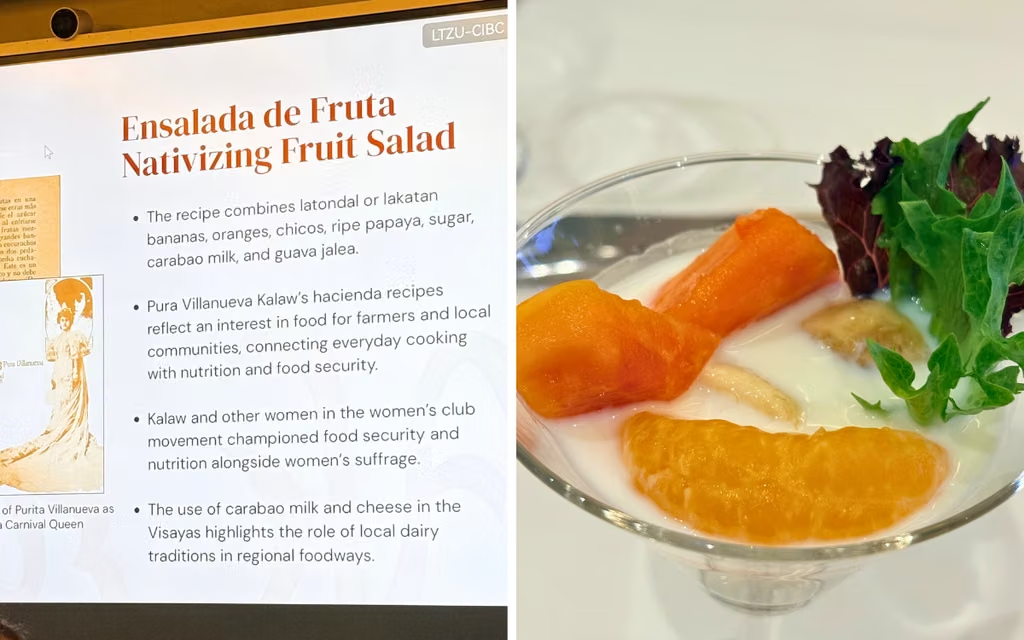
Another merienda item with an interesting etymology is ensalada de fruta. While ensalada is a Spanish word that Filipinos historically used for vinegar- or salt-based vegetable salads (think ensaladang mangga or pako), the sweet, creamy dessert we know today has distinctly 20th-century roots.
Before Spain handed us over to Uncle Sam, Visayans had an abundance of fresh tropical fruits — mangoes, papayas, bananas, and more — which they ate on their own or mixed with coconut. Chef Jessie’s interpretation goes back to this simpler preparation, serving fresh fruits in fresh carabao milk with a piece of lettuce on the side. She was quick to stress that the lettuce was part of the original recipe and not her own idea, washing her hands of what was admittedly an odd choice of garnish.
The sweet, creamy fruit salad we know today emerged from a different culinary influence. Spanish colonial traditions introduced sweet fruit courses, which later mingled with American-era staples like canned fruit cocktail and condensed milk. The result echoes American concoctions like ambrosia salad, where fruit is tossed together in a rich, sweet dressing. By the early 1900s, canned fruits and heavy creams had begun reshaping how Filipinos prepared what had once been a much simpler combination of whatever tropical fruits were in season.
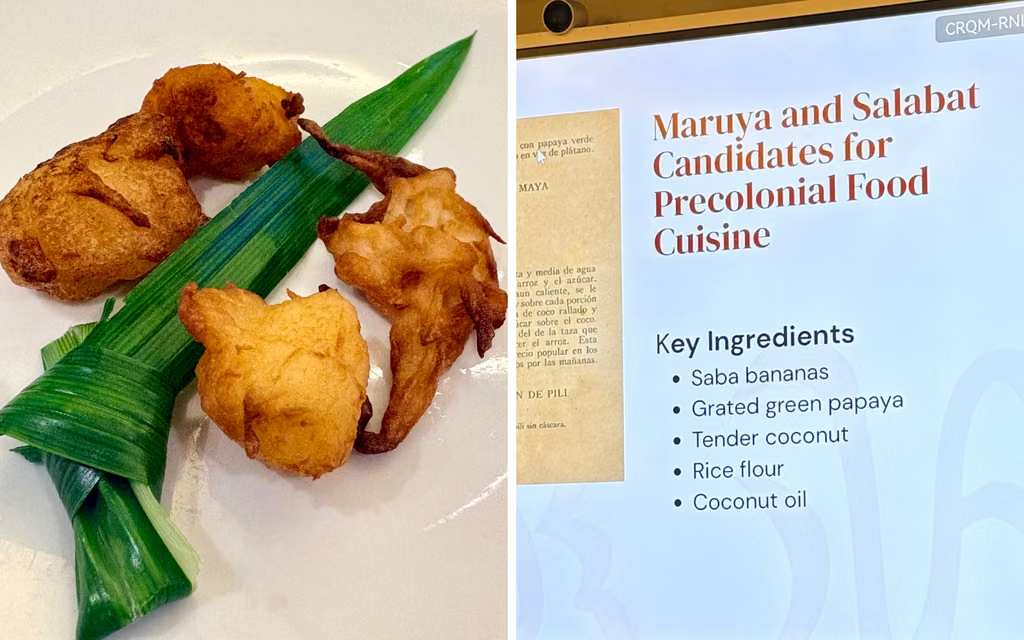
Lastly, there was the simple combination of maruya and salabat (ginger tea). I was surprised by the pairing, as I would have instinctively reached for sikwate — the Visayan take on hot chocolate — instead. The name maruya has Spanish colonial roots, with its etymology often traced to the Spanish term maruyar, meaning to batter and fry. Early colonial records, including Tagalog texts from 1609, describe a form of fried cake made with flour, coconut oil, and honey.
Chef Jessie prepared maruya four ways for us to try: with saba (local sweet plantain), grated green papaya (which was surprisingly sweet), buko (young tender coconut), and kamote (sweet potato). I typically lean towards sweeter things for merienda, so this was my favorite dish that afternoon. I found the salabat a little too strong for my liking (I usually take mine sweetened with honey), but I could appreciate how the punchy ginger cut through the richness of the oil.
Another interesting tidbit Felice shared was the origin of the carinderia, or karinderiya. I’d never really thought about it before and assumed it might have something to do with the kalesa (a two-wheeled, horse-drawn carriage), since the words sounded vaguely similar. Apparently, though, the story goes back to the British occupation of Manila, long before the Americans came along.
According to this account, Indian Sepoy soldiers who deserted the British fleet during the occupation of Manila from 1762 to 1764 eventually settled in towns like Cainta and Taytay in Rizal, where some married Filipina women. They brought with them spice- and curry-based dishes that were introduced to local travelers. The word carinderia is linked to kari, referring to curry or spices, and the word karihan, a place where curry or similar dishes were served.
Cainta and Taytay sat along a major pilgrimage route to Antipolo Church, where devotees traveled in May to pay their respects to the Virgin of Antipolo. Roadside bamboo stalls – the karihan – sprang up to feed hungry pilgrims along the way. By the early 1800s, the carinderia had become a recognized local food shop and resting place for travelers.
Over time, many carinderias evolved into turo-turo establishments (literally, “point-point”), where diners simply point to the pre-cooked dishes they want from metal pots or glass display cases. Today, the carinderia remains a backbone of working-class Filipino food culture, adapting to modern tastes and even mobile setups while holding on to its essential purpose: serving affordable, home-style comfort food to people who need a quick, filling meal.
The Visayan word nayanaya (first documented in 1628) means to entertain, treat a guest like royalty, share food or gifts, and cultivate a sense of warmth, good humor, and mutual happiness.
To end the lecture, Felice shared that there is no straightforward English translation for nayanaya. The word describes the symbiotic joy between host and guest: the host finds happiness in seeing their guests enjoy the food and company, knowing that all the effort they put into entertaining them was worth it, while the guests feel equally happy being cared for. Everyone gives, everyone receives, and everyone leaves feeling a little fuller — in more ways than one.
I think this describes the Filipino, especially the Visayan disposition, to a tee. We’re generous to a fault, and refusing someone’s hospitality can be considered poor form. Which is why, no matter how full you are, you’re expected to at least taste the food you’re offered. It’s just good manners.