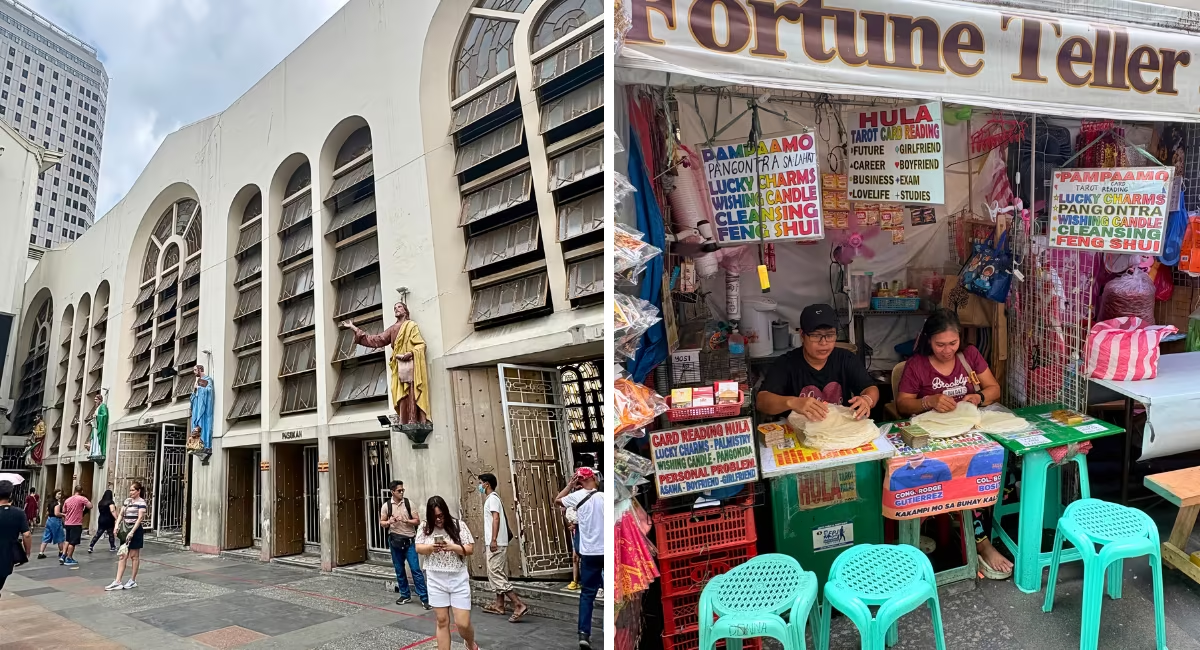
The priest’s voice follows me out of Quiapo Church, his homily still carrying through the open doors as I step into the thick, humid air of the street. The heat clings to my skin, mingling with the smell of sweat and the general commotion of a neighborhood that seems to run on its own peculiar logic. People weave around one another, vendors call out from their stalls, and every available inch of space appears to have something for sale.
The Minor Basilica and National Shrine of Jesus Nazareno, more popularly known as Quiapo Church, is one of the Philippines’ most important centers of Catholic devotion, drawing millions of devotees and pilgrims. For many, it is a place to pray for healing, offer thanks, seek guidance, and ask for help with problems that seem beyond their control. Yet step outside the church and into the surrounding streets, and you find a whole other landscape of belief alongside it.
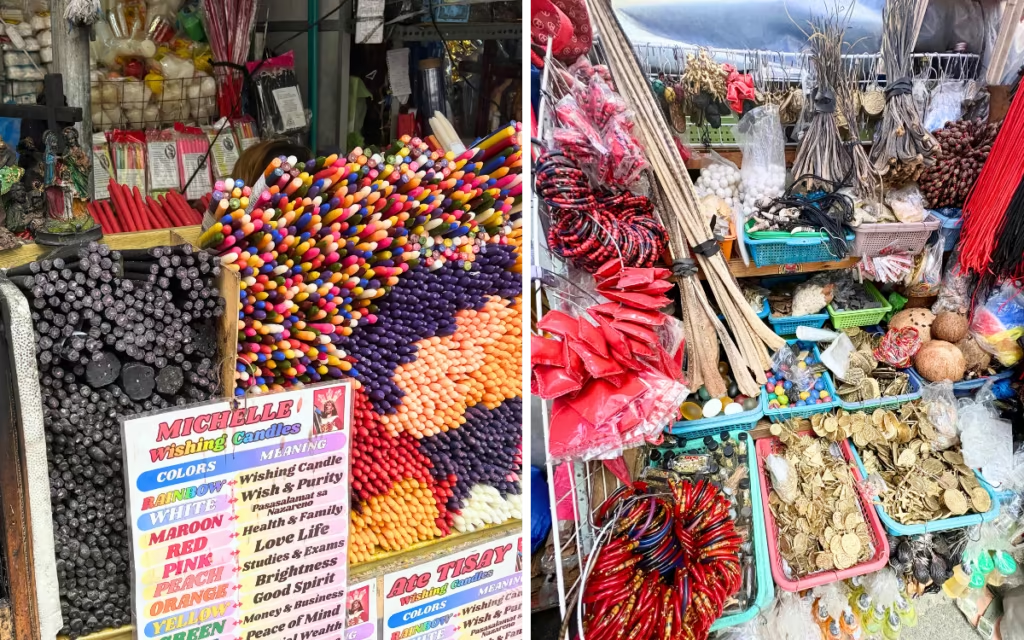
To my left, bundles of wishing candles are stacked in tight rows, their colors bright enough to compete with the religious statues and printed images behind them. Pink candles promise love, green ones better business, and black ones a protection from hexes. A sign spells out the meanings of each shade, turning the business of making wishes into something of a shopping list. Pick your color, state your intention, light your candle, and hope for the best.
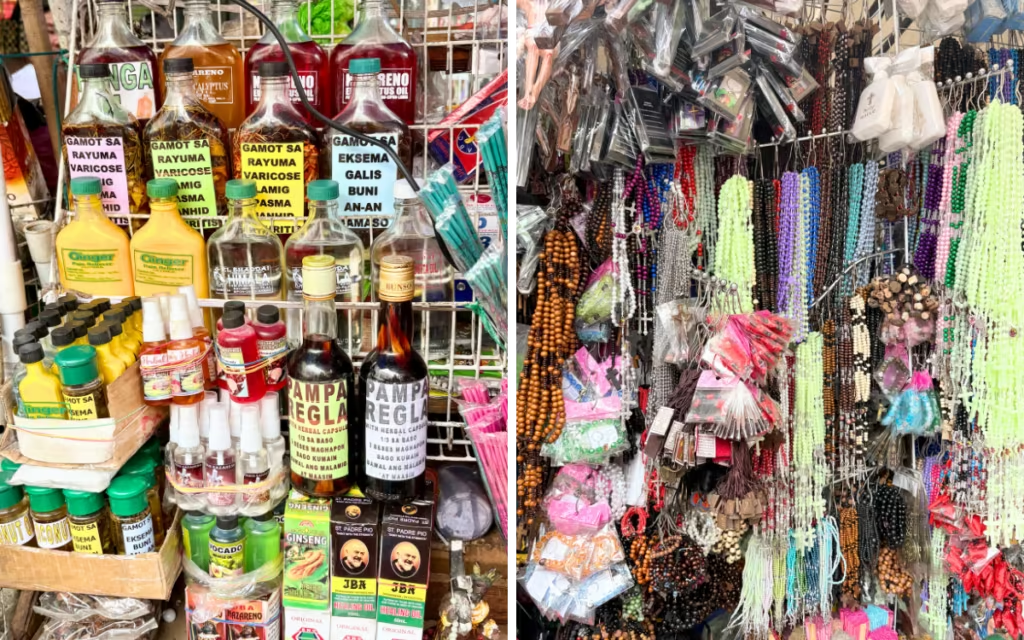
On the other side of the street, fluorescent green rosaries hang beside strings of wooden beads, religious medals, amulets, and bracelets said to protect babies from usog – the Filipino folk belief that a person’s attention or presence can bring on sudden illness or distress, particularly in infants and young children. Farther along, rows of glass and plastic bottles contain herbs steeped in coconut oil, their handwritten labels promising relief from everything from menstrual cramps to arthritis. Some are murky brown, others a clearer amber, all lined up like little remedies for the many things that can go wrong with a human body.
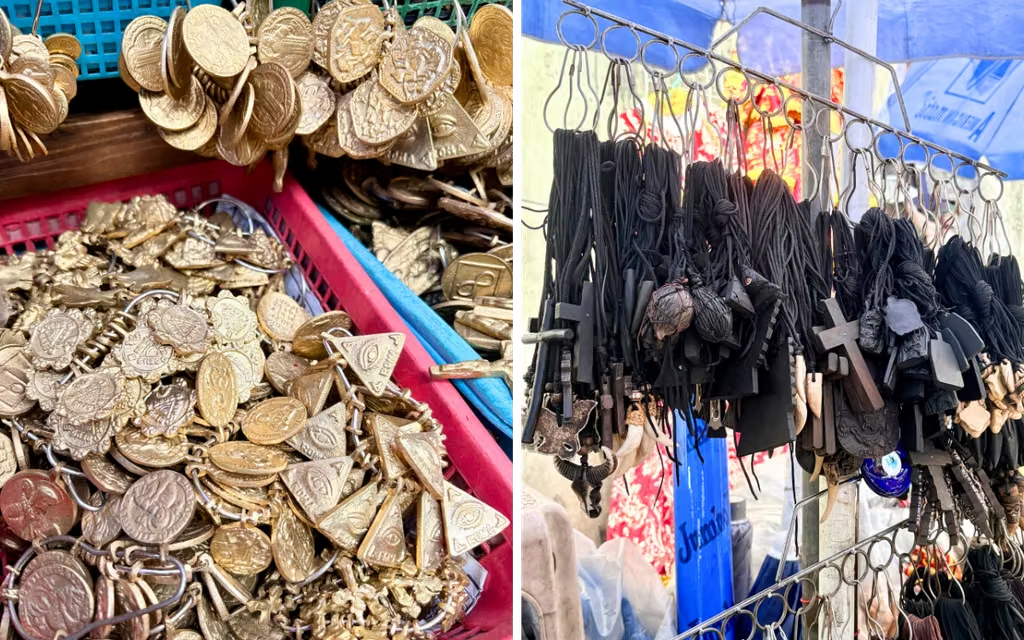
I pick my way through the crowd, stopping now and then to inspect a stall before moving on. I have a very specific mission that afternoon: I’m looking for various anting-anting, Filipino amulets or talismans believed to offer its wearer protection, luck, or spiritual power. In Quiapo, where Catholic devotion shares the pavement with folk healing and all manner of spiritual merchandise, I’m sure I’m in the right place.
Eventually, I make my way towards a row of fortune tellers – they’re very popular in the area and I feel are part of the reason why tarot readers here get such a bad rep. Their stalls are crowded with signs advertising tarot readings, lucky charms, wishing candles, and feng shui consultations. And yet the scene isn’t quite as mystical as the signage might suggest. While waiting for customers, a couple of fortune tellers are busy wrapping lumpia and dumplings, with a bowl of chopped scallions sitting beside their card decks. The juxtaposition delights me: a little divination, a little food preparation, and maybe a snack between readings. In Quiapo, even the business of predicting your future still leaves room for merienda.
Beside me, my very Catholic, rather sheltered, and utterly horrified nephew looks as though he doesn’t know where to direct his eyes – or where not to look. One moment he’s staring at the charms and amulets, the next at the bottles of herbal oils, then at the fortune tellers casually folding wrappers beside their tarot cards. I can practically hear the questions forming in his head. Is any of this allowed? Is it all a little sacrilegious? And why, exactly, did I bring him here?
I’ve always found Quiapo fascinating because the church and its surrounding businesses offer a glimpse into how faith is lived beyond the confines of formal doctrine. Here, Catholic devotion exists alongside folk healing, protective charms, fortune-telling, and inherited superstitions. A rosary might hang beside an amulet, and a a candle lit for a saint might be sold just a few stalls away from a charm intended to ward off bad luck. For some, these practices may seem contradictory. On the streets of Quiapo, they occupy the same space, at times even the same shopping bag.
I realize that my observations might ruffle a few feathers, especially among those who draw a firm line between Catholic faith and folk beliefs. I’m not here to demean anyone’s religion or suggest that I know better than the people who come to Quiapo seeking comfort. I’m simply fascinated by the ways people make sense of the world, particularly when faced with uncertainty, illness, misfortune, or the everyday business of trying to get by.
At the end of the day, people will reach for whatever gives them comfort and helps them face the unknown. For some, that’s prayer; for others, a candle, a bracelet, or a small amulet tucked into a pocket. What interests me isn’t so much deciding which beliefs belong and which don’t, but understanding what they mean to the people who hold them. If a practice brings someone comfort and encourages them to live with a little more kindness and compassion, I’m not particularly interested in policing how they get there.
I think this is what makes Filipino Catholicism so fascinating. We’ve developed our own particular flavor of Roman Catholicism, one that is deeply rooted in the religion brought here by Spanish colonizers, but shaped just as much by the beliefs and customs that existed long before they arrived. For more than 300 years, Catholicism took root in the archipelago, but it didn’t simply replace everything that came before it. Indigenous beliefs and practices were often absorbed, reinterpreted, or folded into the new religion, creating a distinctly Filipino way of understanding and expressing faith.
Religion, after all, was one of the tools Spain used to establish colonial rule. Missionaries often built churches and religious practices around existing communities, adapting Catholic teachings to local customs and familiar ways of relating to the spiritual world. It wasn’t a straightforward swap from one belief system to another. The result was a complicated blending of traditions, some encouraged by the Church, others maintained in spite of it. Centuries later, you can still see traces of that history in the way we pray, the objects we consider sacred, and the rituals we turn to when life gets difficult.
Take the images of saints that fill our churches and homes. Catholicism has a long tradition of religious imagery, of course, but the Filipino relationship with these figures can feel particularly intimate and physical. We don’t just pray to them from a distance. We dress them, carry them through the streets, decorate them, touch them, and bring them into our homes. The image becomes more than a representation of a holy figure; for devotees, it can be a tangible point of connection with the divine. It isn’t difficult to see how this resonates with older Indigenous traditions in which carved figures and material objects could hold spiritual significance, though the histories and meanings of these practices aren’t interchangeable.
Our devotion also has a distinctly communal quality. Faith is something we practice together, in packed churches, along procession routes, in family homes, and in the streets outside parish gates. It’s woven into the calendar, the neighborhood, and the way we gather as a community. Sometimes, it seems as though the entire country operates on a religious schedule.
Consider Simbang Gabi, the series of nine early morning masses beginning on the 16th of December leading up to Christmas. The tradition is commonly associated with making it possible for farmers and fishermen to attend mass before heading out to work. Over time, it became one of the defining rituals of a Filipino Christmas. These days, some churches hold evening masses to accommodate people with work and school schedules, but the spirit of the tradition remains. You show up, you pray, you make your wish, and then you head outside for bibingka, puto bumbong, or whatever warm, comforting snack the vendors have waiting. The church bells ring, the streets are still dark, and suddenly Christmas feels a little closer.
Then there’s the Feast of the Black Nazarene, celebrated on the 9th of January at Quiapo Church. During the Traslacion, the image of Jesus carrying the cross is brought through Manila in a procession that draws enormous crowds of devotees. People arrive barefoot, reach for the ropes of the carriage, and hold out towels and handkerchiefs in the hope of touching the image or bringing home a little of its perceived blessing. The devotion is physical, fervent, and often exhausting. Just this year, organizers reported that approximately 9.64 million people took part in the feast’s activities, with more than a thousand medical incidents recorded during the procession.
To an outsider, the crush of bodies and the desperation to get close to the image might seem extreme. But for many devotees, this isn’t spectacle for spectacle’s sake. It’s an act of gratitude, supplication, sacrifice, or panata – a personal vow made in exchange for a prayer answered, or a way of expressing gratitude for a favor believed to have been granted. Faith here isn’t always quiet contemplation. Sometimes it means enduring hours in a crowd, braving the heat, and placing yourself in the middle of something much larger than yourself because you believe that being there matters.
Then there’s the humble scapular, which to me, illustrates how Filipino Catholicism can take on a distinctly local character. I had friends in college who had been wearing theirs since grade school, given to them by their parent or grandparent, having been instructed never to take them off. The brown cords hung around their necks beneath their uniforms, the little pieces of cloth or plastic resting against their skin. After years of daily wear, some cords had faded almost white from countless showers and soap suds, while others had become tangled and frayed. Yet my friends continued to wear them obediently, as though taking them off would leave them vulnerable to whatever misfortune might be waiting.
In Catholic teaching, the scapular is a devotional object associated with prayer and the intercession of the Virgin Mary, not a magical charm. But the way we sometimes grow up understanding it is worth examining. When a child is told that a small object worn against the skin will help keep them safe, that object can become more than a reminder of faith. It becomes a form of reassurance, something tangible to hold on to in a world full of things we cannot control.
In that sense, the scapular occupies an interesting place alongside the anting-anting. They come from different religious traditions and carry different meanings, but both can become physical expressions of the desire for protection. And that is what fascinates me about Filipino Catholicism: how a religion introduced through colonization became intertwined with the ways we already understood the spiritual world. Our faith isn’t always neatly divided between official doctrine and inherited folk belief. Sometimes, the two coexist in the same person, hanging around the same neck.
And then there’s Holy Week, when much of the country slows down for Semana Santa. Growing up, whenever I spent my holidays in the Philippines and Holy Week rolled around, the entire family was expected to make the trip to our province in Ibaan, Batangas, for the long weekend. As a ten-year-old, I absolutely hated it. We weren’t allowed to watch TV (not that there was much to choose from on the two local channels available anyway), and playing or having fun was strictly forbidden because, as my aunts would remind us, Jesus was dead. Even a child’s afternoon of entertainment would have to wait until the Resurrection.
What I remember most, though, was the Pabasa at the nearby chapel. For hours on end, the elderly women would chant the story of Christ’s passion through a loudspeaker, their voices rising and falling in a mournful, almost otherworldly wail that carried across the neighborhood. To my ten-year-old imagination, it sounded less like a religious observance and more like a coven of witches summoning something sinister. I was equal parts bored, mildly terrified, and desperate for someone to turn the television back on.
Looking back, I can appreciate the devotion and endurance involved in singing or chanting the Pabasa for hours, even through the night. At the time, however, I was mostly preoccupied with how long Jesus was going to stay dead and whether we might be allowed to have fun again once he came back.
Of course, the Pabasa is only one part of the elaborate rituals surrounding Semana Santa. Churches hold long services, streets fill with processions carrying life-sized images of saints, and communities stage the Cenaculo, a dramatic reenactment of Christ’s passion and death. In some communities, penitents engage in acts of self-flagellation, while a smaller number participate in ritual crucifixions. These practices are controversial, and the Church does not teach that such physical suffering is necessary for salvation, but they remain part of the varied ways some Filipinos express sacrifice, repentance, and devotion.
Even as a child, I could see that Holy Week was treated as something more than a series of religious services. It governed how the entire community behaved: what we watched, where we went, how loudly we played, and even whether we were allowed to enjoy ourselves. Faith wasn’t confined to the church. It spilled into our homes, our provincial routines, and the collective understanding that, for a few days, everyone was expected to observe the same rules. I may have resented the restrictions then, but looking back, it’s another example of how deeply Catholicism has woven itself into the rhythms of Filipino life.
Look at these traditions together and a pattern begins to emerge: our faith is often something we want to see, touch, carry, sing, dance, eat, and experience with other people. It lives in the image of a saint, the candle lit for a favor, the procession that brings an entire neighborhood to the street, and the promise made in exchange for a prayer. There’s a kind of bahala na woven through it all, too – not necessarily a passive surrender to fate, but a willingness to face uncertainty while placing trust in something beyond ourselves.
Of course, none of this means every Filipino Catholic believes the same things, or that Indigenous traditions survived unchanged beneath the surface of Catholicism. Our religious lives are far too varied for that. But the particular way faith has developed here tells us something about how Filipinos have made a foreign religion their own: adapting it, personalizing it, and finding ways to make it speak to the hopes and anxieties of everyday life.
And perhaps that’s why the streets around Quiapo Church feel so revealing. The boundary between official religion and folk belief isn’t always as clear in practice as it might appear on paper. A devotee can attend mass, light a candle, buy an amulet, and consult a fortune teller without necessarily seeing these acts as irreconcilable. To someone else, they might look like contradictions. To the person doing them, they may simply be different ways of asking for a little help from God, Bathala, or the universe. Whichever one floats your boat.
Which brings me back to my search for an anting-anting. After wandering around the church and its surrounding stalls, I eventually found what I was looking for in a narrow alley a little farther away from the crowds. There, tucked among the usual neighborhood clutter, sat an old woman selling an assortment of amulets and talismans. She seemed a little hesitant when I approached, eyeing me with the understandable suspicion of someone who wasn’t quite sure what to make of a potential customer – I probably didn’t look like her usual clientele.
I explained that I was interested in learning more about our Indigenous mystical beliefs, having recently fallen down the rabbit hole of Dennis Santos Villegas’ book You Shall Be As Gods. That seemed to put her at ease. Her initial reserve gave way to enthusiasm as she began showing me her wares, picking up one object after another and explaining what each was supposed to do.
There were medallions inscribed with oracion – esoteric prayers and incantations, sometimes written in a form of coded language resembling Pig Latin, believed to offer spiritual protection. There were bullet pendants worn as charms for safe travels, which immediately made me wonder whether this was the sort of belief that had somehow intersected with the infamous laglag bala extortion scheme at NAIA several years ago, when bullets were allegedly planted in passengers’ luggage. The idea of a bullet serving as both a source of fear and a protective charm was an irony that wasn’t lost on me.
She showed me a trespacio medallion, said to protect its wearer against bullets, and tiny duwende amulets clutching pouches of gold, meant to attract wealth and good fortune. There was a kambal tuko amulet associated with fertility, and a Pentacle of Solomon believed to ward off evil spirits. Then came the more unusual objects: ngipin ng kidlat, a stone said to have been struck by lightning, and buntot ng pagi, or stingray tail, traditionally regarded in some folk-belief systems as a physical or spiritual weapon against malevolent forces. The latter was said to help ward off evil spirits, aswangs, tik-tiks, and malicious curses.
Listening to her explain each piece was like being handed a field guide to a world that had always existed alongside the one I knew, but that I’d never taken the time to explore. Each object came with its own story, its own purpose, and its own place in a system of belief that doesn’t always make it into history books. I wasn’t necessarily there to buy into every claim, but I was fascinated by the sheer variety of ways people have sought protection, luck, love, fertility, and a little more control over the uncertainties of life.
It also struck me how easily these beliefs could be dismissed as superstition, particularly by people who have grown up with a more rigid understanding of religion. But these objects carry something beyond their supposed powers. They tell us about the fears people have lived with, the dangers they’ve tried to guard against, and the ingenuity with which they have made sense of the unseen. Some beliefs may have faded, others have adapted, and still others continue to be passed along by people like this woman, who can tell you what an amulet is for as casually as someone else might explain how to use a kitchen utensil.
Quiapo Church and its surrounding streets will always be a point of fascination for me. It’s not simply the church, the devotion, or the dizzying array of things for sale. It’s the way so many layers of Filipino belief seem to converge here: formal Catholicism, folk healing, Indigenous spiritual traditions, inherited superstitions, and the everyday desire to find something that might make life a little less uncertain. It’s messy, contradictory, deeply human, and distinctly ours.
If a foreigner ever asked me to explain our particular flavor of faith, I wouldn’t start with a theology textbook or a lecture on the history of Spanish colonization. I’d bring them here. I’d walk them past the church, through the rows of colored candles and fluorescent rosaries, past the bottles of herbal oil and the fortune tellers wrapping lumpia between readings, and finally into that little alley where an old woman patiently explained the mysteries of her amulets. Because if there’s anywhere that captures the peculiar, fascinating way Filipinos have made faith our own, it’s Quiapo.